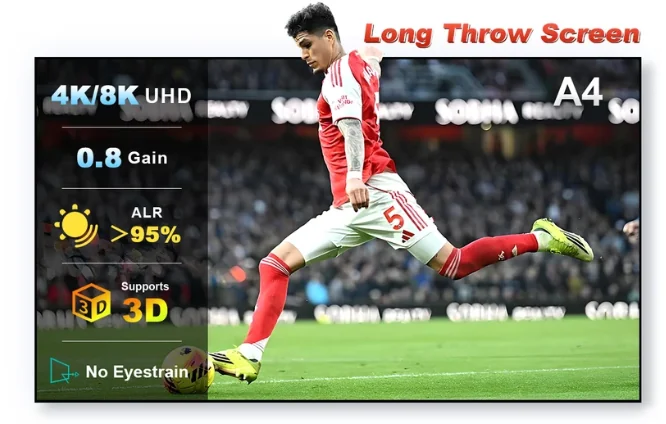
Lenticular and Fresnel are both directional optical approaches, but they manage light differently. That difference can change brightness, ambient-light rejection, seating flexibility and installation sensitivity.
Lenticular surfaces
Lenticular ALR materials use fine repeating structures that can favor projector light while suppressing light arriving from less useful angles. They are common in both UST and long-throw designs, but the orientation is different for each use case.
Fresnel surfaces
Fresnel screens use concentric structures that can concentrate light more strongly toward a defined viewing zone. Long-throw Fresnel products can publish high gain, which helps brightness, but the viewing geometry is often more constrained.
A real long-throw example
NothingProjector lists its long-throw ALR material at 0.8 gain and 170°. Valerion currently lists its long-throw Fresnel screen at 1.8 gain and 90°. Those numbers illustrate the trade-off: more directional brightness concentration versus a wider listed viewing zone.
Which should you choose?
Choose based on projector position, seating width, screen size and ambient-light direction. A Fresnel screen can be attractive when brightness is difficult; a lenticular-style surface may be attractive when wider seating is important. Test rather than assuming the technology name decides the outcome.
Test the material before committing to a full-size screen.
The supplied affiliate offer is for the NothingProjector A4 long-throw screen sample.
Continue your research
NothingProjector vs Valerion Fresnel Long-throw ALR guide Viewing angle explained