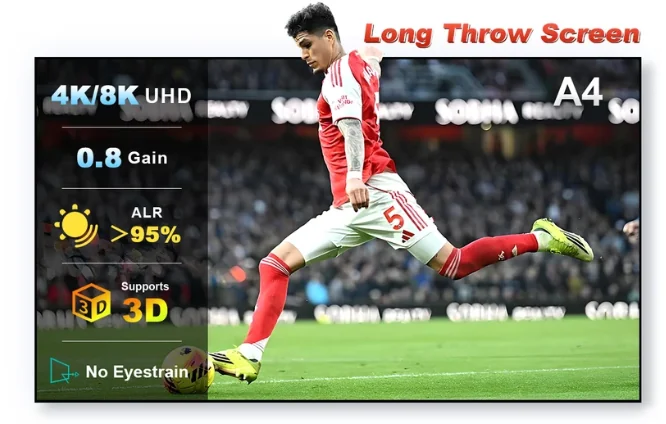
Bottom line: NothingProjector's long-throw ALR material is positioned for standard/long-throw projectors in rooms where ambient light is a real concern. The merchant lists 0.8 gain, 95% ambient-light rejection, a 170° viewing angle, 4K/8K and 3D support, and full-screen sizes from 100 to 130 inches. The affiliate offer on this site is an A4 material sample, which is materially different from buying a full-size screen.
What the A4 sample is for
The sample exists so you can hold the material on the intended wall, project onto it, and judge brightness, black level, color shift, texture and laser speckle under your own lighting. NothingProjector currently says the sample can be refunded after a purchase of its long-throw projector screen if you contact customer service; confirm the current terms on the merchant page before relying on that policy.
Test the material before committing to a full-size screen.
The supplied affiliate offer is for the NothingProjector A4 long-throw screen sample.
Manufacturer-reported specifications
| Attribute | NothingProjector long-throw ALR | Why it matters |
|---|---|---|
| Gain | 0.8 | Below-unity gain can reduce peak brightness while helping control stray light and apparent black level. |
| Ambient light rejection | 95% claimed | Useful only in context: light direction and projector geometry strongly influence real-world results. |
| Viewing angle | 170° listed | Suggests wide seating flexibility, though ALR surfaces can still vary off-axis. |
| Projector type | Standard / long throw | Do not treat this as a UST screen. Optical structures are designed around projector angle. |
| Resolution support | 3D / 4K / 8K listed | Indicates the surface texture is marketed for high-resolution projection. |
| Full-screen sizes | 100–130 inches listed | Enough for common living-room and theater setups, but not every oversized installation. |
Where the material can make sense
- You use a standard or long-throw projector rather than an ultra-short-throw model.
- Your room has daylight, side light, ceiling light or other illumination you cannot fully eliminate.
- You value a darker-looking image in imperfect lighting more than maximum screen brightness.
- You want a wide listed viewing angle for family or group seating.
- You would rather test a swatch in your actual room before committing to a 100–130 inch screen.
Where to be cautious
A 0.8-gain screen sends less light back toward the viewer than a 1.0-gain reference surface, so projector brightness matters. ALR performance is also directional: a marketing percentage cannot fully describe what happens when the room's strongest light source, projector lens and audience occupy different angles.
RGB-laser projectors can also reveal speckle on some screen materials. Independent long-throw screen testing published by The Hook Up in 2026 found that the NothingProjector lenticular long-throw material showed visible laser speckle in its test setup; that is one independent test, not a guarantee of how your projector/room combination will behave. This is exactly the kind of variable an A4 sample can help you judge personally.
Independent testing context
In a 2026 comparison of ten standard-throw screens, The Hook Up measured the NothingProjector lenticular long-throw screen at a calculated gain below the merchant's listed 0.8 and reported overhead ambient-light rejection above 90% in its test geometry. That comparison also found the material visually and microscopically similar to Spectra Shadowscape and Screen Innovations Black Diamond Fusion. These findings are useful context, but they are not a universal specification: measurement method, projector, room and angle all affect results.
How it compares on paper
Versus higher-gain ALR
Valerion's long-throw Fresnel screen is listed at 1.8 gain and 85% ceiling/sidelight rejection. That is a very different brightness/viewing geometry proposition from a 0.8-gain lenticular-style surface.
Versus certified angular-reflective material
Elite Screens CineGrey 3D is listed at 1.2 gain, 90° viewing angle and carries ISF/Greenguard-related certifications. That makes certification and narrower viewing geometry part of the comparison, not just ALR percentage.
What we would verify before a full-size order
- Projector throw ratio and mounting position.
- Peak brightness at your intended screen size.
- Strongest ambient-light direction.
- Whether your projector is RGB laser and whether speckle bothers you.
- Seating width and off-axis brightness tolerance.
- Current full-size availability, shipping and return terms.
FAQ
Is the affiliate product the full-size projector screen?
No. The supplied affiliate URL leads to the A4-size sample product. Screen Signal labels it as a sample everywhere to avoid implying otherwise.
Can a long-throw ALR screen be used with a UST projector?
Do not assume compatibility. The NothingProjector page explicitly positions this material for standard/long-throw projection. UST screens use different optical structures and incidence angles.
Does 95% ALR mean the image will look like a TV in every bright room?
No. ALR percentages depend on test geometry, and the final image depends on projector brightness, screen angle, light direction and room surfaces.
A sample is the most honest first step.
Use your own projector, room and lighting to decide whether this material behaves the way you want before considering a full-size screen.
Continue your research
A4 sample testing guide Pricing & sample cost Long-throw alternatives Best long-throw ALR shortlist