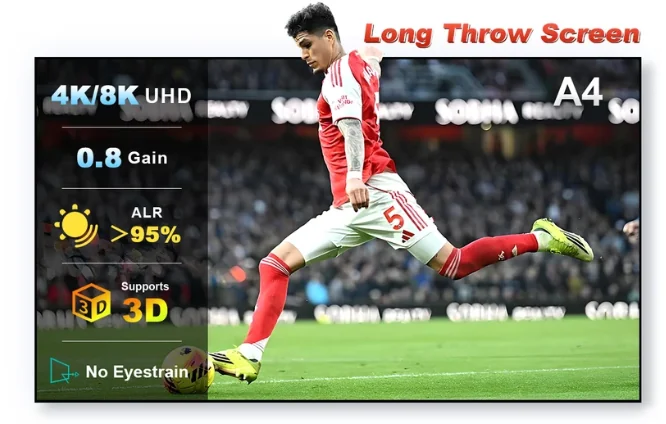
This is one of the clearest optical trade-offs in the category: NothingProjector publishes a lower gain and much wider viewing angle, while Valerion's Fresnel screen publishes much higher gain with a narrower viewing angle.
Specification snapshot
| Attribute | NothingProjector long-throw ALR | Valerion Fresnel ALR |
|---|---|---|
| Gain | 0.8 listed | 1.8 listed |
| Viewing angle | 170° listed | 90° listed |
| Ambient light rejection | 95% claimed | 85% ceiling & sidelight rejection claimed |
| Projector type | Standard/long throw | Long throw |
| Optical approach | Lenticular-style long-throw ALR positioning | Fresnel lens technology |
| Common sizes | 100–130 in listed | 100 and 120 in current listing |
What actually differs
Gain changes the brightness equation
A 1.8-gain Fresnel screen is designed to concentrate more light toward the audience than a 0.8-gain surface. That can be attractive for larger images or bright-room viewing, but higher directional gain usually makes placement and seating geometry more important.
ALR percentages are not directly interchangeable
NothingProjector's 95% figure and Valerion's 85% ceiling/sidelight figure are manufacturer claims using different language and potentially different test geometry. Do not read 95 versus 85 as a universal ten-point performance gap.
Fresnel versus lenticular behavior
Fresnel optics typically manage light using concentric structures and are highly dependent on projector/screen geometry. Lenticular-style ALR materials use a different directional structure. The best fit depends on lens position, light direction and seating.
Independent-test context
In The Hook Up's 2026 long-throw screen test, the Valerion Fresnel screen was reported to perform strongly for ambient-light rejection and laser-speckle reduction. The same test found the NothingProjector long-throw surface behaved differently, with lower measured gain and more visible speckle in that test setup. Those findings are valuable independent evidence, but they describe one projector/room/test method rather than every installation.
Why the A4 sample matters here
Specifications cannot tell you exactly how your projector, light sources and seating geometry will interact with a screen. The NothingProjector affiliate offer on this site is the A4 material sample, so the conversion path is intentionally a low-commitment material check rather than pretending you have already chosen the full-size screen.
Compare with your own projector before committing.
Use the NothingProjector A4 sample to check brightness, color, off-axis behavior and speckle in your actual room.
FAQ
Does higher gain automatically mean Valerion is better?
No. Higher gain can improve brightness but also changes viewing geometry. The better fit depends on room, projector output, mounting and seating.
Why sample NothingProjector first?
Because the A4 sample can expose whether the lower-gain material gives you the contrast and ambient-light behavior you want without unacceptable dimming or speckle.
Continue your research
Comparison hub All alternatives NothingProjector review ALR screen guide