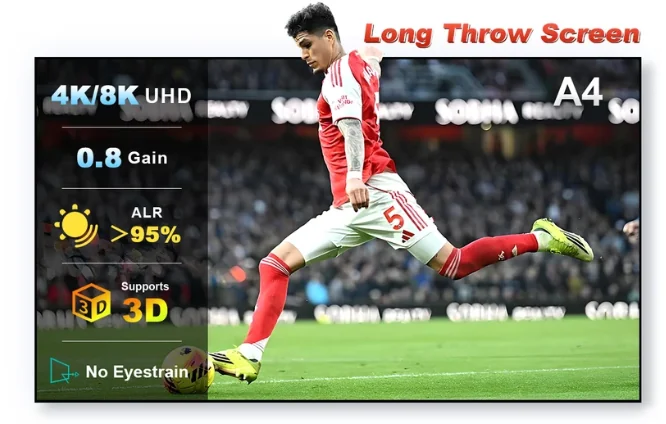
A long-throw ALR screen is built to favor light arriving from the projector's expected direction while suppressing some light from other directions. That can preserve contrast in rooms that are not fully dark, but it also turns screen placement into part of the optical system.
What “long throw ALR” actually means
Long throw describes a projector that sits a meaningful distance from the screen. ALR means ambient-light rejecting. The screen surface is directional: it is engineered to send more desired projector light toward viewers and less unwanted room light toward them.
This is different from a neutral matte-white screen, which reflects light more diffusely. It is also different from UST ALR material, which is designed around a projector firing upward from very close to the bottom of the screen.
The four variables to check first
- Throw geometry: the projector must sit in the angular range the material expects.
- Gain: lower-gain surfaces can deepen apparent blacks but demand more projector light.
- Ambient-light direction: a screen may reject overhead light better than rear or side light.
- Viewing angle: directional optics can look different from different seats.
Why a 95% ALR claim is not the whole story
ALR percentages are manufacturer-specific unless they are measured under the same protocol. A 95% claim does not mean “95% of every room light source disappears.” Direction, wavelength, incidence angle and measurement position matter. Use the number as a clue, then inspect geometry and independent testing.
Long-throw ALR and RGB-laser projectors
Modern RGB-laser projectors can expose laser speckle on some screen surfaces. A material that looks excellent with a lamp or single-laser projector may show fine shimmering with an RGB laser. This is one reason a sample can be more informative than a generic compatibility label.
A practical buying workflow
- Confirm the projector is standard/long throw.
- Measure throw ratio and screen size.
- Map windows and ceiling lights by direction.
- Decide how wide the seating is.
- Check projector brightness at the target size.
- Test material samples when possible.
- Only then compare frame style, warranty and price.
Test the material before committing to a full-size screen.
The supplied affiliate offer is for the NothingProjector A4 long-throw screen sample.
FAQ
Can a long-throw ALR screen work in daylight?
It can improve contrast compared with a neutral white surface under some daylight conditions, but it cannot overpower direct sunlight. Light control still helps.
Do I need ALR in a dedicated dark theater?
Not necessarily. In a truly dark room, a neutral white or gray screen may preserve brightness and uniformity with fewer directional trade-offs.