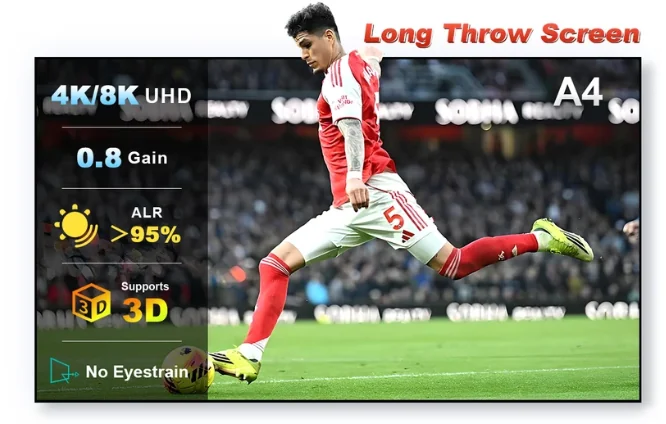
A long-throw projector sends light toward the screen from meters away. A UST projector sends light upward at a steep angle from just below the screen. That geometry difference is why the screen material cannot be treated as interchangeable.
Long-throw screen geometry
Long-throw ALR material is designed around light arriving from a more frontal angle. Some designs reject ceiling and side light while returning frontal projector light to the audience.
UST screen geometry
UST ALR/CLR material is typically oriented to accept steeply rising projector light from below while rejecting light from above. Turn that relationship around and the screen can reject the projector itself.
The NothingProjector sample
The A4 product promoted on this site explicitly says it is compatible with standard/long-throw projectors only. Do not buy it as a proxy for the company's separate UST materials.
Rule of thumb
Match the screen to the throw class first, then compare gain, ALR, size and frame. “ALR” by itself is not a compatibility specification.
Test the material before committing to a full-size screen.
The supplied affiliate offer is for the NothingProjector A4 long-throw screen sample.